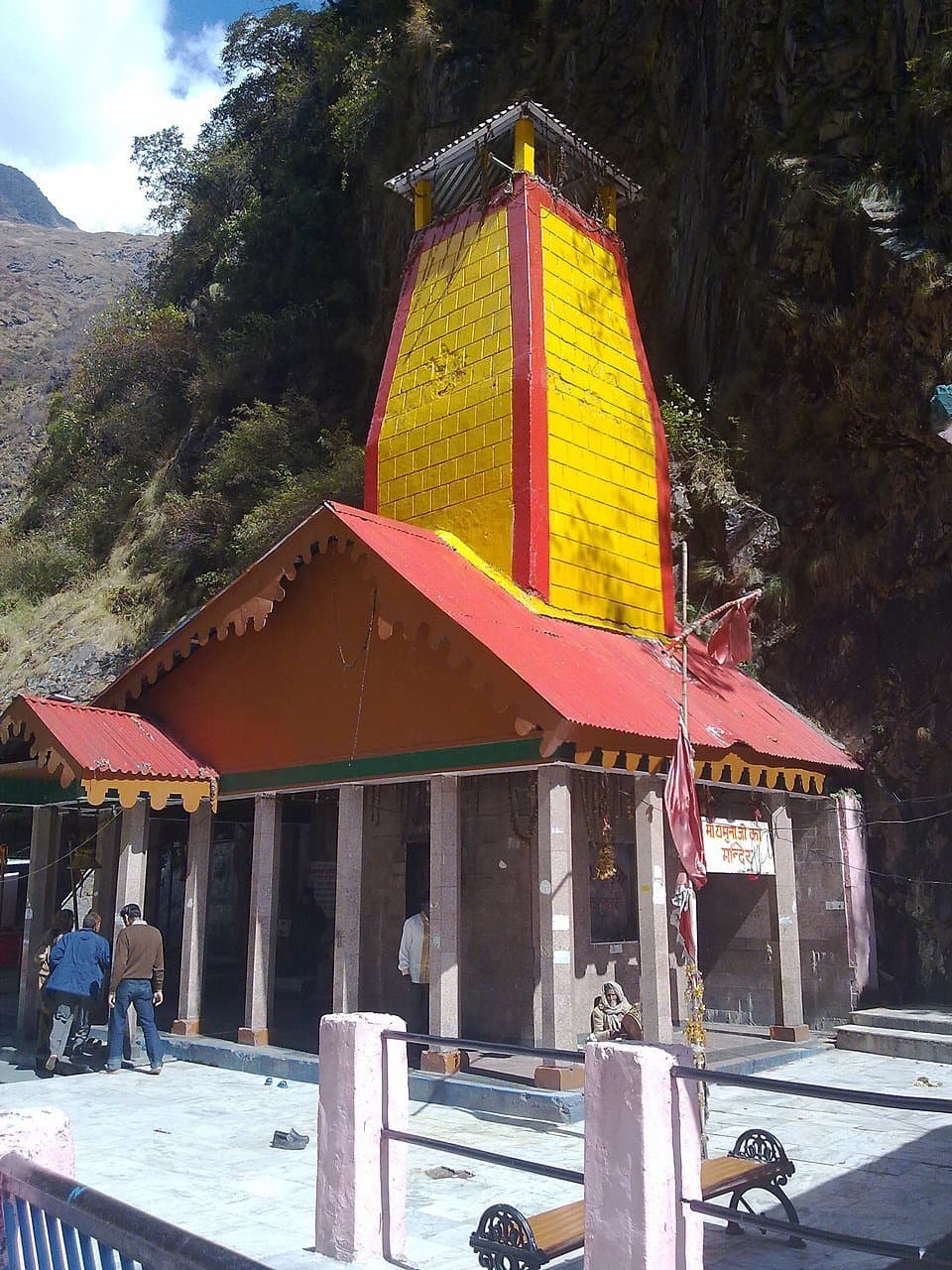
Yamunotri is where Char Dham begins - by tradition, the yatra runs west to east: Yamunotri, Gangotri, Kedarnath, Badrinath. Most people follow the sequence because it makes geographic sense and the route flows naturally along the Uttarakhand mountain highway network.
Of the four dhams, Yamunotri is the least covered online and the most underestimated in person. The trek is only 6 km one way (Janki Chatti to the temple), which sounds easy. At 2,650m starting altitude and 3,293m at the top, it is not difficult by mountain standards - but pilgrims arriving from the plains with no acclimatization sometimes struggle. The altitude gap of 643m over 6 km is manageable, but the body needs time to adjust if you have come straight from Delhi or Dehradun in the same morning.
The temple is smaller than Kedarnath or Badrinath. The setting is tighter - a narrow gorge rather than an open alpine valley. And the Surya Kund hot spring, sitting just beside the temple at approximately 94C, is something I had not seen written about accurately anywhere before I visited. The steam rises off the water in thick columns, the air around it smells faintly sulphuric, and pilgrims lower cloth bags of rice and potatoes into the water to cook prasad. It takes 20 minutes for the potatoes. The family next to me on my first visit shared theirs without being asked.
Why Yamunotri is different from the other three dhams
Most Char Dham content treats Yamunotri as a footnote before the main dhams of Kedarnath and Badrinath. That framing is wrong on a few counts.
Yamunotri is the origin of the Yamuna river - but unlike the Ganga, which originates from the Gangotri glacier, the Yamuna emerges from a rock spring. The Champsar glacier (the technical source of the Yamuna) sits at around 4,421m above the temple, but the water that the temple marks as the sacred source flows from a spring in the rock face at 3,293m. That distinction matters - this is not a glacial melt site. It is a permanent spring with enough heat pressure nearby that the Surya Kund boils at 94C a few metres from the temple entrance.
The second difference: no helicopter. As of 2026, there is no helicopter service operating to Yamunotri. Every single person who reaches the temple has walked the same 6 km trail from Janki Chatti. There is no bypass, no shortcut, no VIP access route. Ponies and palanquins are available, but the path itself is the same for everyone. This creates a different atmosphere at the temple compared to Kedarnath, where a large percentage of visitors arrive by helicopter.
The third difference: crowd character. Yamunotri draws a high proportion of genuine pilgrims rather than tourist-pilgrims. The combination of the compulsory walk and the relative remoteness of the route (175 km from Dehradun via a winding mountain road with limited mobile coverage) filters out casual visitors more than the road-accessible dhams do.
The route from Dehradun - 175 km via Mussoorie-Barkot
175 km via Mussoorie-Kempty Falls junction-Naugaon-Barkot-Janki Chatti. Allow 5-6 hours.
The route is well-defined and the road condition is generally good except for the last 20 km before Janki Chatti, which narrows and gets rougher. A standard sedan (Swift, i10) can make it - many pilgrims drive SUVs and Innovas, which are more comfortable on the rough sections.
Segment breakdown: Dehradun to Mussoorie 30 km (1 hour, uphill switchbacks, avoid 8-10 AM Mussoorie rush). Mussoorie to Kempty Falls junction 8 km (20 min, stay on the Yamunotri road, do not descend to Kempty). Kempty junction to Naugaon 37 km (1.5 hrs, steady descent into the Yamuna valley, road widens). Naugaon to Barkot 80 km (2.5 hrs, longest section, fuel up at Naugaon). Barkot to Janki Chatti 20 km (45 min, narrow and rough final stretch). Total: 175 km, 5-6 hours.
Barkot (155 km from Dehradun, 20 km before Janki Chatti) is the last town with real facilities: hotels, restaurants, one ATM, fuel pumps. Most serious pilgrims stop here the night before. The extra 20 km to Janki Chatti can be driven in the morning in under an hour, giving you a fresh start on the trek.
From Rishikesh: 225 km via Chamba-Barkot. The route is longer but the road from Chamba through the Yamuna valley is well-surfaced. Allow 6-7 hours. Shared taxis from Rishikesh bus stand to Janki Chatti run for Rs 500-700 per seat and take 5-6 hours with stops.
GMOU permit and Char Dham registration
During peak season (April to June, and September-October), vehicles entering the Yamunotri zone require a GMOU green card. This is a government-mandated permit to manage traffic on the narrow roads leading to Janki Chatti.
How to get it: Register online at chardhambooking.com before your trip. The permit specifies your vehicle number and entry date. Checkposts at Barkot verify the permit. Entering without it results in being turned back.
Personal vehicles, hired taxis, and shared vehicles all require this. The permit is separate from the individual pilgrim Char Dham registration (RFID wristband). You need both.
All four Char Dhams require prior registration. Register at registrationandtouristcare.uk.gov.in for an RFID wristband. Carry it throughout the yatra. For full registration and permit details, see the char-dham-epass-permits guide.
The 6 km trek - what to actually expect
The trail from Janki Chatti to Yamunotri temple runs along the Yamuna river gorge. The path is paved stone (well-maintained by the Forest Department and local committees) for approximately 4 of the 6 km, with the last 2 km becoming rougher stone steps. There is no exposed ridge section or technical terrain - this is a path, not a trail.
Grade: moderate. The elevation gain is 643m over 6 km, which works out to roughly 107m per km - comparable to a steep hill walk rather than a mountain ascent. For someone who walks regularly, it is 2 to 2.5 hours up at a comfortable pace. For first-time altitude walkers coming from the plains, budget 3 hours and take breaks.
What the trail looks like: the first 3 km follow the river closely. You will cross two small bridges, pass several chai stalls and small temples, and the sound of the river is constant. The trail then climbs more steeply in the 3-5 km section before flattening slightly in the final approach to the temple complex. There are rest points with stone benches at regular intervals.
Altitude effect: coming from Janki Chatti (2,650m) to the temple (3,293m) in one continuous walk is fine for most people. But pilgrims who have driven from the plains and started the trek immediately on arrival (without a night at Barkot or Janki Chatti) sometimes experience headaches, nausea, or fatigue in the 5-6 km section. If you feel any of these, sit down, drink water, and continue slowly. Do not push through chest tightness or extreme shortness of breath. See the acclimatize-above-3000m guide.
Trail conditions by season: May opening weeks - trail is clear, some loose stone from winter, snow possible above 3,000m in early May. June - best walking conditions, lush, clear skies most mornings. July-August (monsoon) - slippery paved sections, river at high water, some trail damage, trekking shoes with grip are essential. September-October - excellent conditions, cooler than June, post-monsoon greenery. November (closing weeks) - cold 0-8C on trail, possible frost on upper sections, very thin crowds.
Pack the right footwear for the conditions - the wet stone sections catch pilgrims in sandals badly. See trekking-shoes-under-5000 for options that work for this trail without overbuying. A rain poncho is worth carrying even in May - the gorge generates its own weather.
Surya Kund and the temple complex
The trail ends at a short flight of stone steps leading into the temple complex. Before the main temple entrance stands the Divya Shila - a large rock pillar, worshipped by pilgrims before entering the sanctum. Most pilgrims stop here for a brief puja.
Surya Kund is the hot spring immediately adjacent to the temple. The temperature of the water is approximately 94C - close enough to boiling at this altitude that you cannot touch it. The steam rising off the surface is visible from 50 metres. The spring has a raised stone surround and is managed by the temple committee - barriers prevent accidental contact.
What pilgrims do here: cloth bags (usually muslin or cotton) filled with rice, potatoes, or dal are lowered into the Surya Kund water and left to cook for 15-25 minutes. The cooked food becomes prasad. This practice is one of the more unusual pilgrimage customs in the Char Dham circuit, and watching it in action - families gathered around the spring with string-tied cloth bundles, steam rising around them, the cold valley air of 3,293m against the boiling water - stays with you.
I watched a family there in early May, their cloth bags hanging from a stick over the spring. The potatoes took almost exactly 20 minutes. They split them open, pressed in salt from a small packet, and offered me a piece without ceremony. The temperature contrast - scalding potato, cold air - was something I had not eaten before in quite that way.
Gauri Kund is a second, cooler spring approximately 50 metres from Surya Kund. The temperature is more moderate and this is where ritual bathing takes place. Women pilgrims have a dedicated section. The water is still very warm (40-50C range) and the bathing area has basic stone steps.
The temple itself is dedicated to Goddess Yamuna and is smaller than the large temples at Kedarnath and Badrinath. The sanctum is intimate - narrow, low-ceilinged, with the idol visible from a few metres. Crowd management inside the temple is handled by priests who move groups through at a pace. On peak days (Akshaya Tritiya opening, mid-June festival dates), the queue outside can be 1-2 hours. On regular May mornings, queue time is 20-40 minutes.
Temple timings: approximately 6 AM to 12 PM, and 3 PM to 9 PM. These times shift slightly by season and can change year to year - verify at Janki Chatti on arrival or at the temple notice board. The 6 AM opening slot is the least crowded entry of the day.
Pony and palanquin - options if you do not walk
Since there is no helicopter, the alternatives to walking are ponies (horses) and palanquins.
Ponies are available for hire at the Janki Chatti base, managed by a local operator association. You ride up and walk down, or take a return booking.
Rates (2026 season approximate): pony one way (up) Rs 800-1,200. Pony return Rs 1,500-2,000. Palanquin (4-bearer doli) one way Rs 2,500-4,000. Palanquin return Rs 4,500-7,000.
The pony trail overlaps with the walking trail for most of the route. During peak hours (9 AM-12 PM), the trail has simultaneous foot traffic, ponies, and palanquins - this is the most congested window. If you are walking, starting before 7:30 AM or after 1 PM is significantly more pleasant.
Palanquins (dolis) are primarily used by elderly pilgrims or those with mobility limitations. The four bearers carry the chair in shifts. The trail is physically demanding for the bearers - tip appropriately beyond the quoted rate.
On packing: even if you plan to take a pony up, carry a daypack or light backpack with water, a windproof jacket, snacks, and a headlamp in case your return gets delayed past sunset. The temperature at 3,293m drops sharply after 4 PM.
Accommodation - Janki Chatti vs Barkot
Janki Chatti (the roadhead, 2,650m) is a small village with around 30-40 guesthouses and dharamshalas. Options are basic but functional.
Janki Chatti rates: budget guesthouse (shared bathroom) Rs 400-700. Mid-range guesthouse (attached bathroom) Rs 700-1,500. GMVN Tourist Rest House Rs 1,000-2,000. Dharamshala (dormitory) Rs 150-300. The GMVN rest house is the most consistent option - book at gmvnl.in.
Yamunotri itself: a handful of dharamshalas at the temple site (Rs 200-400/night). Very basic - stone buildings, shared facilities, limited blankets. In peak season they fill by early afternoon. If you want to stay at the temple (useful for early morning access), book through the temple trust on arrival at Janki Chatti - there is a counter near the pony booking desk.
Barkot (the better overnight option, 1,220m) is 20 km before Janki Chatti, at a more comfortable altitude, and has substantially better facilities. This is where I stayed on my Dehradun trip.
Barkot rates: budget hotels Rs 600-1,000. Mid-range hotels Rs 1,500-2,500. Better hotels with heater Rs 2,500-3,500.
Barkot has restaurants with proper menus (not just dal-rice), a working ATM (though unreliable on peak season weekends), and a fuel pump. If you arrive from Dehradun in the afternoon, staying at Barkot and driving the 20 km to Janki Chatti the next morning puts you at the trailhead by 7-8 AM - the best window to start the trek.
Cash and ATMs - the actual situation
There is no ATM in Janki Chatti. There is no ATM at Yamunotri. The nearest working ATM is in Barkot, and even that one is reported unreliable (empty by noon on high-traffic weekends in May-June).
Cash required for a typical Yamunotri day: pony one way (if used) Rs 800-1,200. Temple puja / prasad Rs 100-500. Trail chai and snacks (3-4 stops) Rs 150-300. Cloth bag and rice for Surya Kund prasad Rs 50-100. Tips, misc Rs 200-300.
Minimum per person (no pony): Rs 600-1,200. With pony return: Rs 2,500-3,500.
Withdraw cash in Rishikesh or Dehradun before starting the yatra. Budget a minimum of Rs 3,000-4,000 per person for the trek day (more if using ponies or palanquins). See the atm-cash-guide for complete ATM availability along the route.
What to carry for the Yamunotri trek
This is a 6 km uphill walk at altitude, not a multi-day expedition. You do not need heavy gear - but you do need specific things the trail demands.
Non-negotiable: water (at least 1 litre, ideally 1.5 litres - there are refill points but they are seasonal). Rain cover or poncho - the gorge generates afternoon showers even in May. Windproof or insulated jacket - temperature at 3,293m is 8-16C in May, colder in September onwards. Trekking shoes or firm-grip footwear - not sandals, not sneakers without grip on the wet stone sections. Cash (as above).
Useful: thermals if you are visiting October-November or staying overnight at the temple. Headlamp if you are starting early (before sunrise) or returning late. Light daypack to carry the above without a full trekking bag.
Skip: trekking poles are not necessary for this trail (flat to moderate grade, well-paved). Heavy sleeping gear unless staying overnight.
The packing-4000m guide has comprehensive checklists if you are continuing from Yamunotri to Kedarnath on the same trip. See jackets-kedarnath-trek, thermals-high-altitude, rain-ponchos-char-dham, trekking-shoes-under-5000, headlamps-under-1000, and backpacks-chopta-tungnath for specific gear recommendations.
Best time to go - month by month
The season runs from the Akshaya Tritiya opening (typically first or second week of May) to Kartik Purnima or Diwali in late October or November. The closing date is set each year by the Char Dham committee and announced 4-6 weeks in advance.
May (opening through mid-May): low crowd, clear weather, energetic atmosphere of the new season. Some snow possible on the upper trail in the first two weeks - gaiters help. My preferred window.
Late May-June: peak season. Akshaya Tritiya brings the largest opening-day crowd (often 3,000-5,000 pilgrims in a single day at Yamunotri). The trail gets congested between 9 AM and 1 PM on peak days. Start before 7 AM or plan an afternoon ascent.
July-August (monsoon): doable but carry rain gear and check trail status daily. The Yamuna can rise significantly and some trail sections near the river get slippery. Crowd drops sharply after the June rush - you will have a quieter experience but with the trade-off of weather risk. The monsoon-routes guide has the full risk picture.
September-October: second-best window. Post-monsoon clarity, lower crowds than June, temperature starting to drop (8-18C on the trail). October in particular is excellent - cold enough to need a jacket but stable enough for clean skies.
November (closing): the last 2-3 weeks of the season bring thin crowds and very cold conditions. The upper trail can have frost and ice. Only worth attempting if you have the gear for it.
How many days to plan
One day from Barkot: drive 20 km to Janki Chatti, trek 6 km up (2-3 hours), temple visit (1-2 hours), trek down (1.5-2 hours), drive back to Barkot. Long day (12-14 hours total) but doable if you start by 6 AM.
Two days from Dehradun (recommended): Day 1 Dehradun to Barkot (5-6 hours), overnight. Day 2 Barkot to Janki Chatti, trek, temple, return to Barkot or continue to Dehradun. The right structure for most people - you get a rest night at Barkot before the trek, which makes the 643m elevation gain more manageable.
Three days (full Yamunotri experience): Day 1 Dehradun to Janki Chatti (via Barkot stop for lunch). Day 2 Trek up, stay overnight at the temple dharamshala, early morning temple at 6 AM. Day 3 Trek down, drive back. This lets you see the temple at dawn, when the crowd is thin and the steam from Surya Kund is most visible in the cold morning air.
Combined with Gangotri: Yamunotri and Gangotri are 220 km apart by road (via Uttarkashi). Combining them is possible in a 5-day trip from Dehradun. Standard route: Dehradun - Barkot - Yamunotri - Uttarkashi - Gangotri - Dehradun. See the gangotri page for accommodation at Uttarkashi. If you are also planning Kedarnath and Badrinath, see the rishikesh guide for planning your Char Dham starting base.
When to go
What to pack
A full packing checklist is available to tick off and share. Start with these essentials, then adjust for the current forecast, route and your own needs: