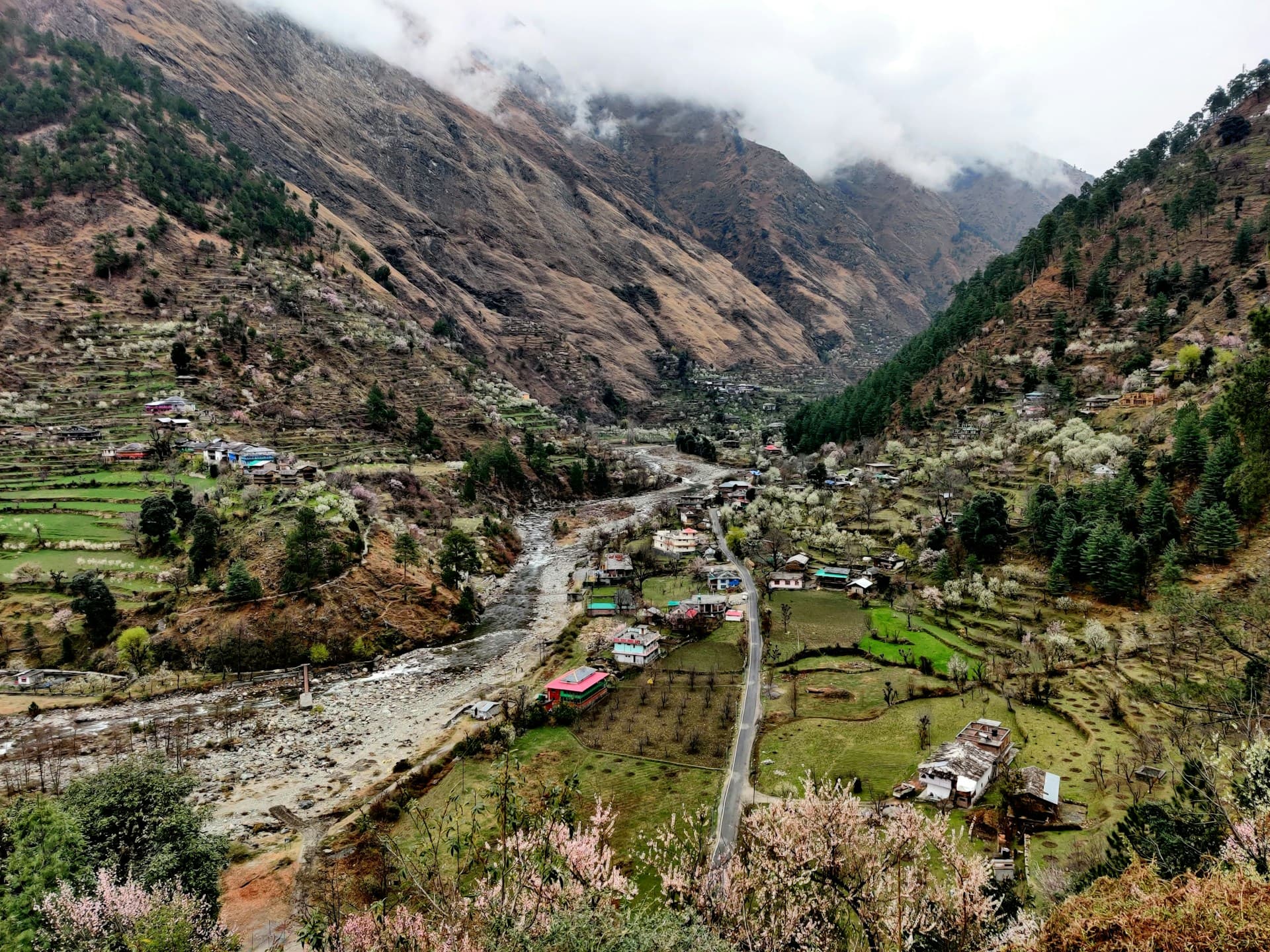
Most people who ask me about Tirthan Valley have already confused it with Manali. They are not the same. Tirthan Valley sits south of Kullu, not north. The road to Banjaar - the main market village at the valley's entry - branches off the Kullu-Manali highway at Larji junction, just past the hydro dam, and heads west. That turn-off sends most people on the Manali highway sailing right past it.
That is partly why Tirthan remains what it is: a valley where the river is clear enough to count brown trout from the bank, where you need a permit and an empanelled guide to enter the core zone of one of India's only UNESCO-listed national parks, and where the only ATM is 60 km away in Kullu. I drove here from Dehradun in September. Early morning the next day, standing at the river's edge with a local guide, watching trout hold position against the current - there was not another trekker in sight for the entire morning. That is unusual for Himachal Pradesh in September.
This page covers what you actually need to know: how to get here from Dehradun, how the GHNP permit system works (the buffer zone and core zone are different things with different rules), what the Serolsar Lake trek involves, and the logistics around fishing.
Getting to Tirthan Valley from Dehradun
Route: Dehradun - Chandigarh - Bilaspur - Mandi - Kullu - Bhuntar - Larji junction - Banjaar.
The total distance is 340 km. With mountain road conditions from Mandi onward, budget 8-9 hours. This is not a highway that rewards speed. The Mandi-Kullu section runs along the Beas River and has construction delays in some years - add 30-45 minutes as a buffer if you are traveling in the summer months.
The critical turn most people miss: at Larji junction, just after the Larji hydro dam, take the left turn toward Banjaar. You are now on the Tirthan Valley road. From Larji to Banjaar is 50 km and takes about 1.5 hours on the winding single-lane road through Ghiyagi and Gushaini.
Key distances from Dehradun: Dehradun to Chandigarh 98 km (2 hrs). Chandigarh to Bilaspur 88 km (1.5 hrs). Bilaspur to Mandi 62 km (1.5 hrs). Mandi to Bhuntar 60 km (1.5 hrs). Bhuntar to Larji 15 km. Larji to Banjaar 50 km (1.5 hrs). Total 340 km, 8-9 hours.
Leave Dehradun by 5:30 AM and you reach Banjaar by 3-4 PM, which leaves enough daylight to sort accommodation and plan the next day.
By bus: HRTC operates overnight buses from Delhi to Bhuntar (about 12-13 hours, Rs 700-900 in ordinary, Rs 1,200-1,500 in Volvo). From Bhuntar, local buses or shared taxis run to Banjaar (50 km, Rs 120-180 by local bus, or Rs 800-1,000 for a private taxi). From Dehradun, take a bus to Chandigarh or Mandi and connect from there - no direct Dehradun-Banjaar bus operates.
By air: Kullu-Manali Airport (IATA KUU) at Bhuntar handles limited flights - mostly from Delhi. Airfare varies wildly but cab to Banjaar from Bhuntar costs Rs 900-1,200 and takes 1.5 hours.
Cash before you leave: there is no ATM in Banjaar. The nearest reliable ATM is in Kullu, 60 km back the way you came. Carry cash from Chandigarh, Mandi, or Manali. Most homestays, guides, and the GHNP permit office are cash-only. See the atm-cash-guide.
GHNP - how the permit system actually works
Most online articles about Tirthan Valley wave at GHNP as if it is one thing you can simply walk into. It is not. The park operates two distinct zones with separate permit structures and different access rules. Getting this wrong costs you a wasted trip.
Buffer zone (Ecozone): the buffer zone is the outer ring of GHNP. You can enter this area with a basic permit. Permit cost Rs 50/day for Indian nationals, Rs 200/day for foreign nationals. Guide not mandatory in the ecozone. Get the permit at the GHNP reception office at Sai Ropa (on the road between Banjaar and Gushaini) or from the checkpoint at park entry points. What is accessible: forest trails, birding, day hikes, river access near Gushaini. The Serolsar Lake trek from Jalori Pass sits in the buffer zone territory and does not require a core zone permit.
Core zone: the protected interior of GHNP. This is where the Western Tragopan (HP's state bird), Himalayan brown bear, snow leopard, and Himalayan tahr live with genuine wilderness around them. Entering requires: permit Rs 200/day for Indian nationals. Guide mandatory - the guide must be empanelled by GHNP. Your guesthouse in Banjaar can help connect you, but book in advance during peak season. No independent camping inside core zone - camping is only allowed at designated spots, and even that requires advance authorization. Booking through the GHNP reception office at Sai Ropa, 5 km from Banjaar toward Gushaini. Arrive early - the office opens at 9 AM and guided groups fill up, particularly in September-October.
Check the GHNP official site (greathimalayanpark.com) for current permit fees and guide empanelment lists. Cross-check fees before you go as they are revised periodically.
The Rolla camping area, 10 km inside the core zone from the Gushaini entry point, is one of the most-cited overnight spots. It sits on the Tirthan River inside the park, with high probability of bird sightings and good trout habitat. Catch and release is mandatory inside the core.
Serolsar Lake trek - from Jalori Pass
This is the most accessible trek in the Tirthan area for anyone who does not want to deal with GHNP core zone logistics. It is in the buffer zone, requires only the basic permit, and can be done without a guide - though hiring a local one for Rs 500-700 for the day is worth it for birding knowledge.
Trailhead: Jalori Pass, 3,120m. The pass is 30 km from Banjaar by road and accessible by vehicle (shared taxis from Banjaar, Rs 150-250/seat). The road is open roughly June to October - snow blocks it for the rest of the year, usually closing sometime in November and reopening after May.
The trek itself: distance 6 km one-way from Jalori Pass to Serolsar Lake (3,100m). The trail descends slightly from the pass before leveling out through birch and oak forest. Trek time 1.5-2 hours one-way, 3-4 hours round trip. Difficulty easy to moderate. The path is clear and well-walked. The altitude at 3,100m means you will notice the thin air if you have arrived directly from low elevation - do not rush the pace.
The lake itself is small (around 100m across) and sits in a depression surrounded by birch forest. There is a small temple - Budhi Nagin - at the lake edge with religious significance to local communities. Photography is permitted but be respectful around the temple structure.
For anyone who has done the chopta or har-ki-dun routes, Serolsar is shorter and lower-impact - a half-day rather than multi-day undertaking. The packing-4000m guide is overkill for this trek but useful if you are extending to other Himachal routes.
Best months: late May through October. Snow may persist on the trail until early June in some years. Carry rain gear from July to early September.
Trout fishing in the Tirthan River
Tirthan has some of the best trout fishing in India. The river holds brown trout (introduced colonial-era) and rainbow trout in healthy population densities, particularly in the upper sections beyond Gushaini. This is one of the few destinations where casual visitors can fish with guides without serious advance planning.
License and permit: HP Fisheries Department issues fishing licenses at their office in Banjaar. Cost is Rs 100-200 per day for Indian nationals. Foreign nationals pay a higher rate (confirm at the office). No online booking - visit in person with ID proof. The license specifies the river section and date range. Outside GHNP, both catch-keep and catch-release are permitted. Inside GHNP, catch-release only.
Best months: March-June and September-November. Peak fishing in early summer (April-May) when the river is clear after winter snow melt has settled. Avoid July-August - the river is high and muddy from monsoon.
Guide: local guides charge Rs 800-1,500 per day for fishing trips, often including rod and reel rental if you do not have your own equipment. Some homestays in Gushaini and the upper valley have arrangements with empanelled fishing guides. Ask your hosts.
Equipment: bring your own if you fish regularly. Local rental is available but quality is mixed - serviceable but not high-grade. Lures and flies from Indian fishing suppliers (online or specialty stores in Delhi/Bangalore) work better than what is sold locally.
GHNP zones and activity comparison: Serolsar Lake trek is buffer zone, basic permit Rs 50, no guide needed, best Jun-Oct. Riverside walk near Gushaini is buffer zone, Rs 50, no guide, Apr-Nov. Birding/wildlife walks in core zone need Rs 200 permit + empanelled guide, best Sep-Nov. Rolla camping in core zone needs Rs 200 + camping authorization, Sep-Oct only. Tirthan River fishing outside GHNP needs HP Fisheries license Rs 100-200, Mar-Jun and Sep-Nov. Fishing inside GHNP needs core permit + fishing permit, catch and release only. Jalori Pass drive is outside GHNP, no permit needed, Jun-Oct.
Banjaar and where to stay
Banjaar is the main market village in the valley at 1,885m. It has the GHNP reception office, the HP Fisheries office, basic shops, and bus connections back to Bhuntar. The village itself is small - a single main street with a few restaurants, a couple of guesthouses, and the institutional buildings.
Most serious visitors stay in homestays scattered through the valley between Banjaar and Gushaini (10 km up-valley). The character of these stays is quite different from typical Himachal hotels - many are family-run farmhouses with 3-6 rooms, hosts who cook traditional Himachali food, and a slower pace generally.
Accommodation options: budget homestays Rs 800-1,500/night including meals. Mid-range eco-lodges and riverside cottages Rs 2,000-4,500/night. High-end eco-resorts (Raju's Cottage at Goshaini, Himalayan Trout House) Rs 4,500-8,000/night - book several weeks ahead.
The distinguishing feature: most decent homestays in Tirthan include all meals in the room rate, with food cooked using local ingredients. Trout (where in season) is often on the menu. Vegetarian options are excellent - rajma, kadhi, and seasonal saag are standard.
Location choice: Banjaar village itself is the most convenient for permits and shops but the least scenic. Gushaini (10 km up-valley) is the closest village to GHNP and most fishing operators. The stretches between Banjaar and Gushaini have the most beautiful homestay sites along the river.
Month-by-month guide
March: cool, river clearing post-winter, early fishing possible. Snow still on Jalori Pass road. Crowds low.
April: peak fishing month, river clear, valley flowers blooming. Jalori Pass road usually opens late April. Excellent overall.
May: warm days, cold nights, full GHNP access possible. Wildflower meadows at altitude. Pleasant fishing.
June: pre-monsoon period, occasional showers, river still fishable. Jalori Pass open. Most varied month for activities.
July: monsoon onset. River high and muddy. Trekking trails slippery. Fishing largely paused. Skip unless you specifically want monsoon greenery and quiet.
August: peak monsoon. Most activities limited. Landslide risk on Larji road.
September: monsoon ends mid-month. Post-monsoon clarity. River clearing for fishing. Excellent month.
October: best month overall. Stable weather, clear views, full activity availability. Trekking conditions ideal. Book ahead - this is peak.
November: cold, Jalori Pass closes by mid-month or later. Valley still accessible. Fewer crowds.
December-February: cold and quiet. Some homestays close. GHNP largely inactive. Only worth a visit if you want minimum crowds and do not need outdoor activities.
See the monsoon-routes guide for assessing North Sikkim road conditions in July-September specifically - the Lachung highway is prone to landslips at Chungthang.
What to pack
Tirthan is not a high-altitude destination by Himalayan standards (Banjaar 1,885m, Jalori Pass 3,120m), but the temperature range from valley to pass is significant and the weather pattern is variable.
Layering essentials: a fleece or mid-layer jacket is needed even in summer evenings. Banjaar nights drop to 8-12C in May-June, 2-5C in October. See jackets-kedarnath-trek for tested options.
Footwear: walking shoes with grip for the Serolsar trail and any riverside walks. The trails are forest paths with roots and occasional muddy sections - canvas shoes are inadequate but full mountaineering boots are overkill. See trekking-shoes-under-5000.
Rain gear: a packable rain poncho is non-negotiable. Tirthan gets afternoon showers even in clear seasons. See rain-ponchos-char-dham.
Backpack: a 25-30L daypack is sufficient for the Serolsar trek and most valley walks. See backpacks-chopta-tungnath.
Fishing-specific: rod, reel, lures, polarized sunglasses, waders if you have them. Most rentable equipment locally is functional but mid-grade.
Binoculars: if you are interested in birds, GHNP has 209 documented species. Even casual interest justifies basic 8x42 binoculars.
Cash: budget Rs 5,000-8,000 in cash for a 3-4 day trip from Banjaar. ATMs in Kullu only.
The packing-4000m guide is overkill for Tirthan but useful if you are extending to higher Himachal destinations after.
Budget breakdown
Getting there: Dehradun to Banjaar by bus + connecting taxi Rs 1,000-1,500. Dehradun to Banjaar by self-driven car (fuel + tolls) Rs 2,500-3,500.
Accommodation (per night): budget homestay Rs 800-1,500 (often includes meals). Mid-range eco-lodge Rs 2,000-4,500. High-end eco-resort Rs 4,500-8,000.
Permits and activities: GHNP buffer zone Rs 50/day. GHNP core zone Rs 200/day. Fishing license Rs 100-200/day. Empanelled guide Rs 700-1,200/day. Fishing guide Rs 800-1,500/day.
Transport within valley: shared taxi Banjaar to Jalori Pass Rs 150-250/seat. Private taxi Rs 1,200-1,800.
Food: most homestays include meals. If eating out, dhabas in Banjaar Rs 100-200/meal.
Total for 3 nights (Banjaar/Gushaini, mixed homestay, Serolsar trek + GHNP buffer + fishing): Rs 4,000-6,000 per person including permits and a fishing day. Add Rs 4,500-7,000 if going into the GHNP core zone with guide.
Nearby destinations worth combining: Kasol/Parvati Valley is 60 km from Bhuntar (opposite valley from Tirthan). Manali is 80 km from Banjaar via Bhuntar. Dharamshala is further west. See the kasol, manali, and dharamshala pages.
When to go
What to pack
A full packing checklist is available to tick off and share. Start with these essentials, then adjust for the current forecast, route and your own needs: