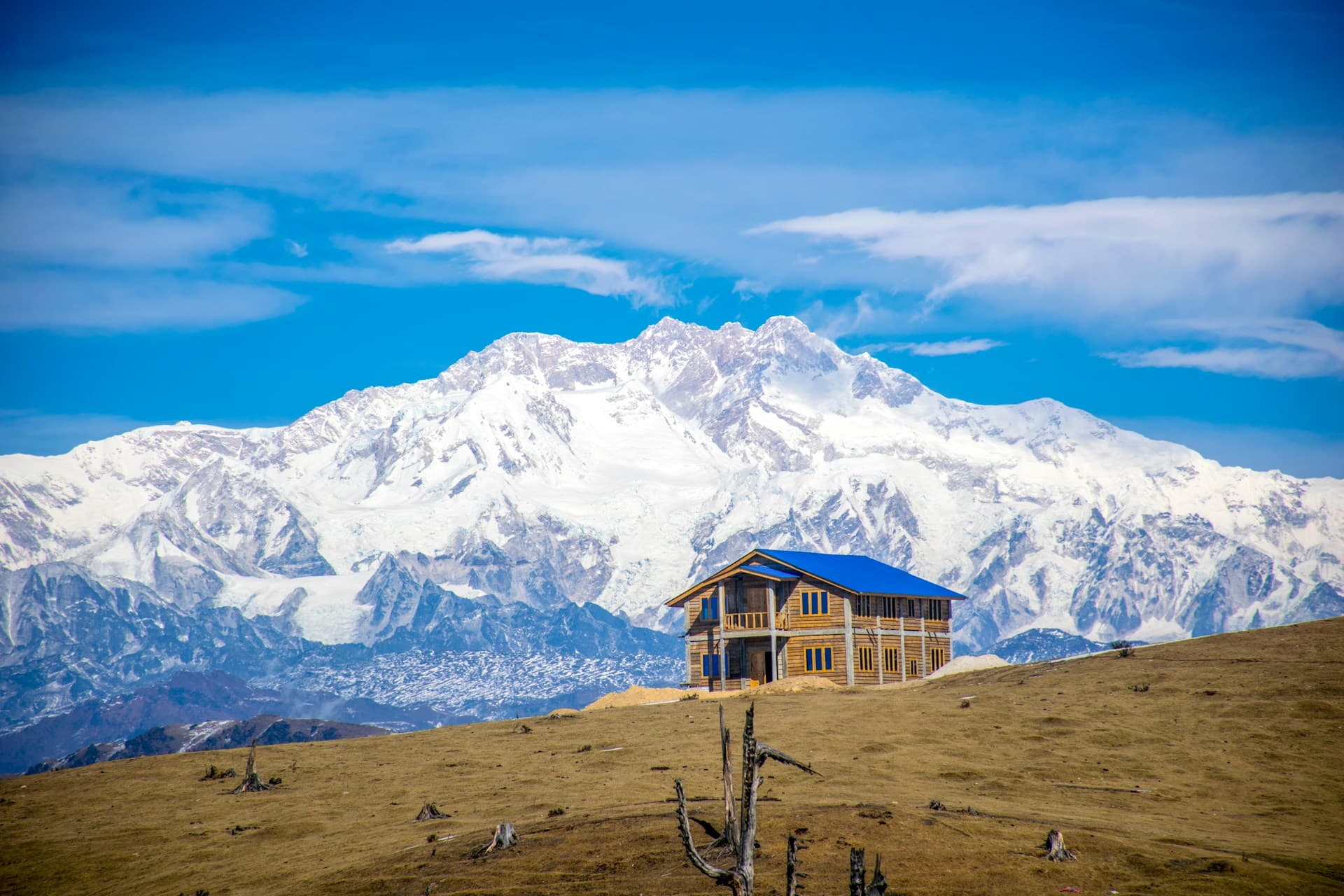
Let me say upfront: Sandakphu is not a destination I would recommend visiting impulsively from Dehradun. It is 680 km away - fly Dehradun to Bagdogra (1.5 hours), then 3-4 hours by road to Darjeeling, then another 1.5 hours to Manebhanjang. It takes more planning than any trek in Uttarakhand. The journey itself is a significant commitment.
But here is the one fact that makes it worth every hour of travel: from the summit of Sandakphu at 3,636m, you can see Kangchenjunga (8,586m), Lhotse (8,516m), Makalu (8,485m), and Everest (8,848m) from a single vantage point. Four of the world's five highest peaks, lined up on the horizon before 6 AM. No other trekking destination in India offers this. That is the reason people come here.
I flew from Dehradun to Bagdogra on a Tuesday morning, took a Land Rover from Manebhanjang to Sandakphu the next day (4.5 hours on the roughest 32 km of road I have ever sat through - the vehicle averaged 8 km/h), and checked into the WBTDC Trekkers Hut at the summit. At 4:45 AM I walked 100 metres from the hut door to the summit viewpoint. Kangchenjunga filled the eastern sky, pink and white, like something painted on a wall. Everest was a small triangle 200 km away, barely distinguishable until the guide pointed to it. The guide named each peak for me. I would never have identified them alone. That 90 minutes at the viewpoint was worth the flight, the road, and the 8 km/h Land Rover.
Getting there from Dehradun
This is farther than any trek I cover on TravelBoa. Sandakphu sits in Darjeeling district, West Bengal, close to the Nepal border. The most practical approach from Dehradun is to fly.
Step 1 - Fly Dehradun (DED) to Bagdogra (IXB): Dehradun's Jolly Grant Airport has regular IndiGo and Air India flights to Bagdogra, the airport that serves Darjeeling and Siliguri. Flight time is approximately 1.5 hours. Fares range from Rs 3,000 to Rs 8,000 one way depending on how far in advance you book. Book at least 3-4 weeks ahead for October travel, when the route is busiest.
Step 2 - Bagdogra to NJP (New Jalpaiguri): New Jalpaiguri is 12 km from Bagdogra. If you are arriving late or need to catch an early train onward, NJP is the main railway junction for the region. A shared auto or taxi from Bagdogra to NJP costs Rs 30-100.
Step 3 - NJP or Bagdogra to Darjeeling: shared jeeps from Siliguri bus stand to Darjeeling run throughout the day - Rs 200-250 per seat, 3-4 hours on the mountain road (70 km). Private taxis cost Rs 1,500-2,000 and are faster. The Darjeeling Himalayan Railway toy train from NJP to Darjeeling is a UNESCO World Heritage route (8 hours, scenic but slow - better as an experience than a transit option).
Step 4 - Darjeeling to Manebhanjang: Manebhanjang is 26 km from Darjeeling town, on the road toward the Singalila ridge. Shared jeeps run from Darjeeling's motor stand throughout the morning - Rs 150/seat, approximately 1.5 hours. The road climbs steadily from Darjeeling's 2,042m to Manebhanjang's 2,134m.
Total journey time from Dehradun: plan 1 full day of travel. A 6 AM flight from Dehradun can get you to Manebhanjang by 3-4 PM the same day if connections work cleanly. More realistically, plan a night in Darjeeling or Manebhanjang before starting the trek or Land Rover.
The summit and what you actually see
The claim attached to Sandakphu is specific: it is the only place in India from which you can see four of the world's five highest peaks simultaneously.
Standing at 3,636m on the Singalila Ridge, looking north and northwest into the dawn:
Kangchenjunga (8,586m): dominates the eastern horizon. Third highest mountain in the world. At sunrise it turns copper-pink. At this distance (approximately 50 km) it appears as a massive, multi-summited wall. You cannot miss it.
Everest (8,848m): 200 km away, in Nepal. Partially visible as a triangular peak. Without a guide pointing it out, most people miss it or mistake it for another peak.
Lhotse (8,516m): fourth highest, appears adjacent to Everest and can be spotted once you know where to look.
Makalu (8,485m): fifth highest, a pyramid-shaped summit visible to the right of Everest-Lhotse.
The viewing window is narrow: 5:00-6:30 AM, before morning cloud builds from the valleys. The best conditions occur in October-November and in January when the air is driest. In April-May, mist and cloud frequently interrupt the view - the rhododendron forests below are spectacular compensation, but do not bank on clear summit panoramas in spring.
If you are coming specifically for the views, October or November is the month. Acclimatizing properly above 3,000m matters here - 3,636m is high enough that some people feel the altitude, especially if they have come from sea level without adequate time.
The 4-day trek - Manebhanjang to Sandakphu
The trekking route runs along the Singalila Ridge - the actual India-Nepal border. The entire walk is along or near this ridge, which means you cross back and forth between India and Nepal multiple times. Indian citizens do not need a passport for this - a voter ID or Aadhaar card is sufficient. Foreign nationals should check current regulations before going.
The trail is well-defined. Tea houses appear every 3-5 km. This is not a wilderness camping trek - you sleep in tea house dormitories or private rooms, eat dal-rice and noodle soup, and refill water at each stop. The Singalila National Park route is one of the more civilized Himalayan treks in terms of infrastructure.
Day 1 - Manebhanjang (2,134m) to Tumling (2,970m): 11 km, 5-6 hours, altitude gain 836m. The trek begins at the Manebhanjang forest department gate where you obtain your national park permit. The climb to Tumling is the steepest section of the entire route - 836 vertical metres in 11 km. The trail passes through Chitrey (2,438m) about 3 km in, a good spot for the first break. Beyond Chitrey the forest thickens and the ridge starts to open up. Tumling straddles the India-Nepal border almost exactly. Tea houses on both sides. WBTDC runs a small guesthouse, private tea houses charge Rs 400-600/person including dinner and breakfast.
Day 2 - Tumling (2,970m) to Kalipokhri (3,186m): 14 km, 6-7 hours, altitude gain 216m. The longest day by distance but more gradual than Day 1. The trail meanders along the ridge with views alternating between the Indian valley (Teesta valley side) and the Nepali side. You will pass through Gairibas (2,621m) and Kala Pokhri before arriving at Kalipokhri. Kalipokhri means black lake - a small glacial lake sits just below the village and is considered sacred. Tea houses fill in peak season. Arrive by 3 PM in October. Rooms Rs 500-700 including meals.
Day 3 - Kalipokhri (3,186m) to Sandakphu (3,636m): 7 km, 3-4 hours, altitude gain 450m. Intentionally the shortest day. The plan is to arrive at Sandakphu by noon, rest, eat, and sleep by 8 PM so you can be at the viewpoint by 5 AM. The final climb crosses through Bikheybhanjang (3,100m) and Sabarkum before the last push to the summit. The WBTDC Trekkers Hut at Sandakphu should be booked in advance, especially for October-November. The West Bengal Tourism Development Corporation office in Kolkata handles bookings, and the online booking portal (wbtdcl.com) is the easiest method. Private Sherpa lodges at the summit are an alternative - Rs 500-800/person including meals.
Day 4 - Return to Manebhanjang: most trekkers take a Land Rover back from Sandakphu to Manebhanjang on Day 4 - shared Land Rover costs Rs 800-1,000/person. The 32 km return on foot would take 7-8 hours and after 3 days of ascent, the knees generally say no. Alternatively, some extend the route south to Phalut (3,600m), a further 21 km from Sandakphu on the ridge, for wider views of the Kangchenjunga massif. Phalut is a 2-day extension that requires prior planning.
The Land Rover route - and trek vs vehicle comparison
This is one of the few treks in India where a genuine alternative to walking exists. The 4WD track from Manebhanjang to Sandakphu predates the trekking boom - it was built for the tea gardens and border patrol, and has been operated by vintage Land Rovers (many 1960s-70s Series II and III models) by local associations for decades.
These are not comfortable vehicles. The road averages 8 km/h - not because the drivers are cautious, but because the road is that rough. Rocks, ruts, mud crossings, and switchbacks without guardrails. In 4.5 hours you cover 32 km. You arrive at Sandakphu having seen the route from a vehicle window rather than on foot, but you have saved 3 days.
The practical use case for most visitors is: Land Rover one way, trek the other. Trek up over 4 days and return by Land Rover, or - as I did - Land Rover up, experience the summit, and trek down at a relaxed pace over 2-3 days.
Trek vs Land Rover comparison: 4-day trek takes 4 days up + 1 day return, costs Rs 2,000-3,000 (accommodation + food), needs moderate-high fitness (32 km, 1,500m gain over 4 days), gives panoramic ridge views throughout plus summit. Land Rover takes 4-5 hours each way, costs Rs 400-600/seat shared or Rs 3,000-4,500 private, needs no fitness, gives summit views only (plus windows on the route), extremely rough 4WD track.
Most guides online position this as an either/or. In practice, combining both gives you the best version of Sandakphu: trek up (or down) to experience the ridge, take a Land Rover for the direction you do not trek.
Permits and guides
Singalila National Park entry permit: Indian citizens Rs 100 per day. Foreign nationals Rs 200 per day. Obtained at the forest department gate at Manebhanjang.
A guide is compulsory inside Singalila National Park. This is enforced, not optional. The guide typically doubles as the permit holder and handles paperwork at checkpoints along the route. Guide fees run Rs 700-1,000 per day. For a 4-day trek, budget Rs 2,800-4,000 for the guide.
Guides can be arranged through tea houses in Manebhanjang, through Darjeeling-based trekking operators, or through the West Bengal Forest Department permit office. The Singalila National Park office in Manebhanjang is the direct contact point for permits and guide registration.
If you are arranging this independently (which you can), show up at Manebhanjang by 8 AM, sort your permit at the gate, and find a guide through the tea houses near the checkpoint. Guides are always available in October-November because that is the peak season. Off-season (January-March, after monsoon lifts in late September) may require a day's notice.
Tea houses along the Singalila Ridge
Unlike trekking routes in Uttarakhand or Himachal, the Singalila Ridge has consistent tea house infrastructure throughout. You do not need to carry a tent, a sleeping bag (though one helps in winter), or cooking equipment.
Tea houses appear every 3-5 km. Each serves Tibetan bread (flatbread fried in oil, filling and calorie-dense), noodle soup, dal-rice with basic sabzi, Maggi (this appears everywhere in the Himalayas), chai, black tea, and occasional coffee.
Room rates at tea houses: Rs 400-800 per person including dinner and breakfast. Dormitory beds on the cheaper end, private rooms on the higher end.
The trade-off versus camping: you lose flexibility on timing (you need to reach a village before dark) but gain warmth, food, and no extra equipment weight.
Key accommodation stops: Tumling (2,970m) - WBTDC guesthouse + several private tea houses. Gairibas (2,621m) - small tea houses, sometimes skipped as a sleep stop. Kalipokhri (3,186m) - limited options, book early in October. Sandakphu (3,636m) - WBTDC Trekkers Hut (advance booking essential) + private Sherpa lodges. Sabarkum - alternative to Sandakphu summit night for those who do not book ahead.
Mobile signal: Airtel and BSNL have patchy coverage along the ridge. Do not count on it for navigation - carry an offline map (OsmAnd or Maps.me downloaded for the Darjeeling region). A power bank is necessary, tea houses have charging points but they are shared and slow.
What to pack
The Singalila Ridge sits at altitude but it is not a technical climb. You do not need crampons or ice axes. What you do need:
Footwear: waterproof trekking shoes with ankle support. The trail is rocky throughout and wet patches appear even in October. See trekking-shoes-under-5000 for tested options.
Jacket: a windproof, insulated outer layer is essential. Pre-dawn at 3,636m in October sits around 2-5C, in January it is -5 to -10C. See jackets-kedarnath-trek for options that apply to Sandakphu's temperature range.
Thermals: base layer thermals make the difference at the summit. See thermals-high-altitude.
Backpack: a 40-50L pack works for the 4-day trek. See backpacks-chopta-tungnath for tested options.
Rain protection: April-May is rhododendron season and also unpredictable rain. October has occasional afternoon showers. A rain poncho or waterproof pack cover saves everything. See rain-ponchos-char-dham.
Headlamp: essential for the 4:45 AM summit walk. See headlamps-under-1000.
Cash: Manebhanjang has no ATM. The nearest ATM is in Darjeeling town. Carry all cash for the trek before leaving Darjeeling. Tea houses are cash-only. For Sandakphu, carry at least Rs 5,000-6,000 in cash before you leave Darjeeling. See atm-cash-guide.
The full packing-4000m guide has the broader checklist - most of it applies directly to Sandakphu.
Best time to visit
October-November (recommended): clear skies, dry trail, stable weather. This is the window where the panoramic views are most reliable. Temperatures at the summit: 5-10C during the day, 0-5C at night. October mornings at the viewpoint are typically cloud-free from 5-7 AM. This is when I went. This is what I would recommend.
April-May (rhododendron season): the route through the lower forest sections (Manebhanjang to Tumling) passes through rhododendron forest - red, white, and pink at bloom in April. The views from the summit are less reliable due to morning haze and afternoon cloud. You may get a clear morning, you may not. The forest is spectacular regardless.
December-January: the clearest air and sharpest views. Everest is more visible in winter than in other seasons. The trade-off: sub-zero temperatures at the summit (-5 to -15C), snow on the trail, and significantly harder conditions for beginners. Go only if you have appropriate sleeping bags and cold-weather gear.
Monsoon (June-September) - avoid: the trail becomes slippery and views are blocked by cloud throughout. The monsoon-routes guide explains why most Himalayan treks shut down or become significantly harder in this period. Sandakphu is not an exception.
Altitude and health
At 3,636m, Sandakphu sits just below the altitude range where most people start feeling acute mountain sickness symptoms. The 4-day trek itinerary is well-paced for gradual acclimatization - the slow ascent over multiple days allows your body to adjust.
Red flags to watch on the trail: persistent headache that does not resolve with paracetamol and rest. Nausea or vomiting. Loss of coordination. Confusion or inability to concentrate.
If symptoms appear above Tumling (Day 1 endpoint), descend. The descent to lower altitude is the only reliable cure. The acclimatize-above-3000m guide covers this in detail.
If you are taking the Land Rover option - ascending 1,500m in 4.5 hours - be aware that your body has not had 4 days to adjust. Drink 3-4 litres of water on the day of ascent and do not exert yourself on arrival. Sleep is rough at altitude for the first night regardless of how you ascend.
Budget breakdown
Getting there from Dehradun: Dehradun to Bagdogra flight one way Rs 3,000-8,000. Bagdogra/NJP to Darjeeling Rs 200-300 shared or Rs 1,500-2,000 private. Darjeeling to Manebhanjang Rs 150/seat shared.
On the trek (4 days, per person): accommodation + meals Rs 400-800/night x 3 nights = Rs 1,200-2,400. National park permit Rs 100/day x 4 days = Rs 400. Guide Rs 700-1,000/day x 4 days = Rs 2,800-4,000. Miscellaneous snacks and tea Rs 500-800.
Return Land Rover (Sandakphu to Manebhanjang): Rs 800-1,000/person shared.
Total per person excluding flights and Darjeeling stay: approximately Rs 6,000-9,000 for the trek + permits + guide + return vehicle.
Including flights both ways (Dehradun to Bagdogra and back): budget Rs 15,000-25,000 for the full trip, depending on flight prices.
Sandakphu vs other mountain treks: Sandakphu occupies a different category from Uttarakhand treks. It is not close to Dehradun, it requires a flight, and the logistics involve more coordination than Chopta or Har Ki Dun. But the views it offers - four 8,000m peaks from a single point - are genuinely unique in India. Compared to Roopkund (5,029m), Sandakphu is lower altitude and technically easier. Compared to Ladakh trips, it is far more beginner-accessible in terms of trekking infrastructure (tea houses, guides, defined trail).
When to go
What to pack
A full packing checklist is available to tick off and share. Start with these essentials, then adjust for the current forecast, route and your own needs: