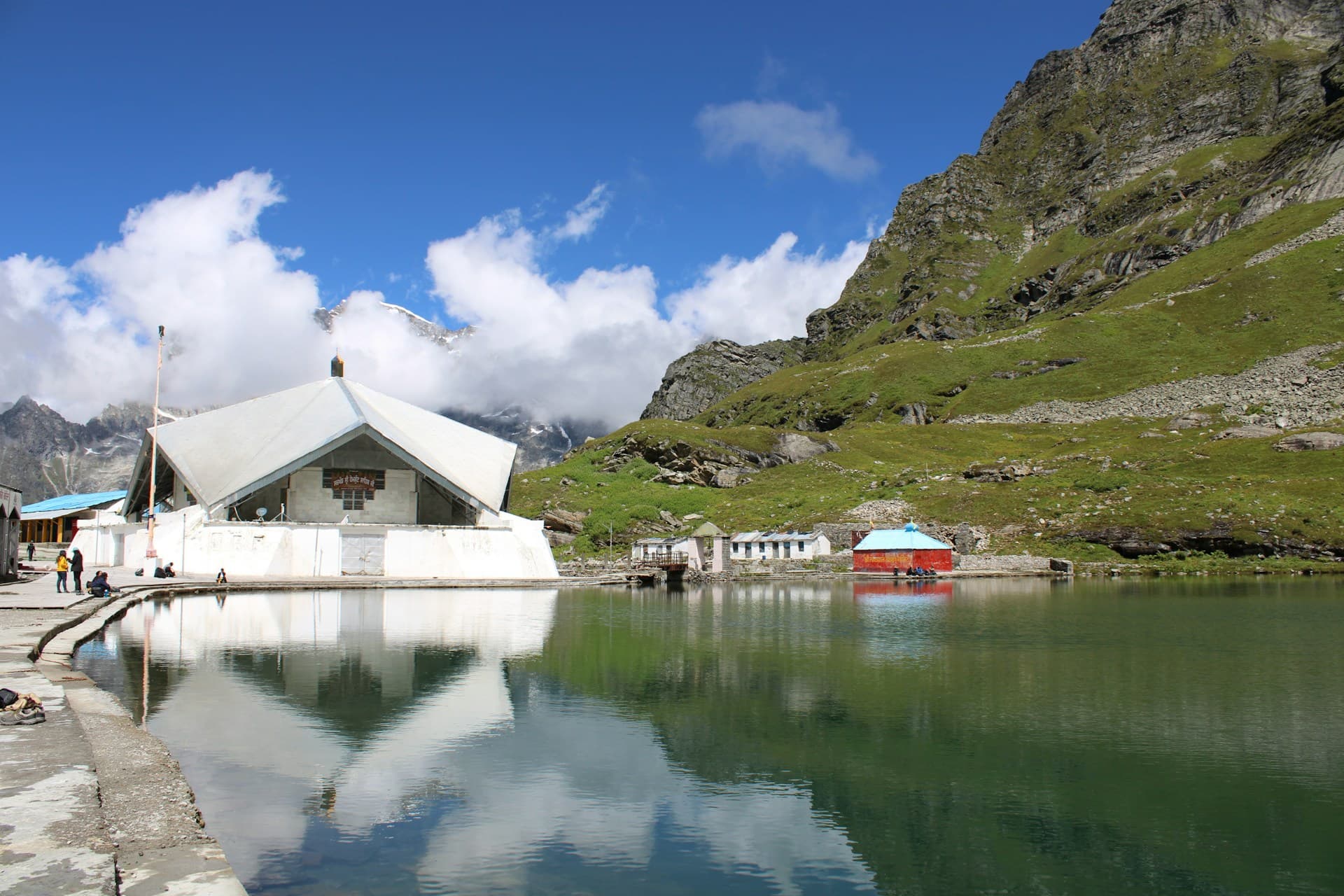
Hemkund Sahib is not a trek you do casually. From Ghangaria base camp at 1,900m to the Gurudwara at 4,329m, you gain 2,429 metres of altitude in 6 kilometres. That is not a gradient you can pace around - the trail climbs hard for most of the route, and in June, the upper section above 3,500m is still under 2-3 metres of snow. You navigate by the wooden pole markers driven into the snowpack, and one wrong step on the wrong side of those poles can start a slide.
I did the Hemkund trek starting from Ghangaria at 5 AM with a headlamp. By the time I reached 3,500m, the trail was under 1.5 metres of snow. The pole markers were the only guide. The Gurudwara appeared out of the cloud at 8:30 AM, the lake a steel-grey plate below seven peaks. I sat in the langar hall, ate dal and roti, and stayed for an hour watching pilgrims arrive - some in their 70s, some barefoot on the snow. I was back in Ghangaria by 11 AM, before the afternoon cloud closed everything in.
This page is a logistics guide for the Hemkund Sahib yatra - route, costs, transport options, the altitude risk that every pilgrim should understand, and how to fold it into a Valley of Flowers trip without rushing either.
Getting to Govindghat from Dehradun
Govindghat on NH-7 in Chamoli district is the starting point for both Hemkund Sahib and Valley of Flowers. From Dehradun, 290 km via Rishikesh and Joshimath, 8-9 hours in good conditions - this is Himalayan driving, not highway driving.
Route breakdown: Dehradun to Rishikesh 42 km (1 hour), Rishikesh to Devprayag 70 km (1.5-2 hrs, river gorge road), Devprayag to Rudraprayag 72 km (1.5-2 hrs), Rudraprayag to Chamoli 79 km (2 hrs), Chamoli to Joshimath 20 km (45 min), Joshimath to Govindghat 25 km (45 min).
Transport from Rishikesh: shared taxi to Joshimath Rs 400-600 per seat, 6-7 hours. Taxis leave from Rishikesh Bus Stand near the main market from 5-6 AM - they leave when full, no fixed schedule. Private cab Dehradun to Govindghat Rs 4,500-6,000 - better for groups of 4+ because it gives schedule control and can stop at Joshimath for acclimatization. GMOU/state buses Rs 200-300 but slower.
Most people drive straight through from Dehradun or Rishikesh in one day, arriving Govindghat by evening, sleeping at a basic guesthouse, and starting the Ghangaria trek the next morning.
Parking at Govindghat: paid parking near the trailhead, Rs 50-100/day for cars. For a 4-day trip, budget Rs 200-400 total.
Before you leave Rishikesh or Joshimath: withdraw cash. No reliable ATM at Govindghat or Ghangaria. Carry at least Rs 4,000-5,000 in cash for the Ghangaria portion - ponies, accommodation, food, and pony hires are all cash-only. See the atm-cash-guide for Joshimath ATM specifics.
Govindghat to Ghangaria - walk, pony, or helicopter
The 13 km trail from Govindghat to Ghangaria is the approach to both Hemkund Sahib and Valley of Flowers. In peak season (late June to mid-August), heavily trafficked - pilgrims, trekkers, mules carrying supplies, ponies carrying visitors.
The first 4 km to Pulna village are relatively flat and can be skipped by jeep (Rs 50-100 per seat). Beyond Pulna, the trail climbs steadily through forest, crossing the Pushpawati river, reaching Bhyundar village before the final climb to Ghangaria.
Three options:
Walking: Rs 0, 4-6 hours, moderate fitness needed. Best for acclimatization.
Pony: Rs 700-900 one way, 3-4 hours at pony pace, minimal fitness. Best for elderly, children, heavy packs.
Helicopter: Rs 2,800-3,500 one way, 10 minutes, no fitness needed. Best for time-limited pilgrims or those physically unable to trek. Operates from Govindghat helipad, weather-dependent - morning slots are more reliable than afternoon. Check current bookings at uttarakhandtourism.gov.in or the GMVN counter at Govindghat. Helicopters carry 5-6 passengers per flight. In June and October, availability is better than peak August when it books out days ahead.
Walking is the better choice for acclimatization. If you are planning Hemkund Sahib (4,329m), walking from Govindghat to Ghangaria over 4-6 hours gives your body time to start adjusting to altitude before the harder Ghangaria-Hemkund section. Taking the helicopter and immediately attempting Hemkund the next morning is a common cause of altitude sickness problems.
Ghangaria base camp
Ghangaria is a seasonal settlement - nothing here in winter, a small town in summer. Sits at approximately 1,900-3,050m (sources vary) at the junction of trails to Valley of Flowers and Hemkund Sahib. The Gurudwara Hemkund Sahib trust runs significant infrastructure here, including accommodation.
Where to stay:
Gurdwara accommodation (Hemkund Sahib Trust): free or donation-based, basic dormitory rooms, blankets provided. Intended for pilgrims, clean and well-managed. Priority to those on yatra but not restricted to Sikhs.
GMVN Tourist Rest House Ghangaria: Rs 1,000-2,500/night. Most structured accommodation. Book at gmvnl.in before arriving - July-August fills quickly.
Private guesthouses: multiple in season, Rs 600-1,500. Walk-in availability weekdays; weekends in August are different.
Food: dhabas sell dal, roti, rice, maggi, aloo sabji, chai - Rs 150-250/meal. The Gurudwara langar in Ghangaria is also available - free, basic, filling. Budget approach: langar dinner + light dhaba breakfast before the trek.
Network and ATM: BSNL has the best (intermittent) coverage in Ghangaria. Jio and Airtel largely absent. Download offline maps of the route on Maps.me or Google Maps offline before Govindghat. No ATM at Ghangaria - final reminder about the Joshimath ATM stop.
Ghangaria to Hemkund Sahib - the hard 6 km
The main event. 6 km, 2,429m altitude gain, 3-4 hours up, and it earns every one of those hours.
The trail starts gently through pine forest, then transitions to open alpine terrain around 2,500m. Above 3,000m the trail steepens noticeably. Above 3,500m in June and early July, you are on snow - hard-packed in the morning, softening as the day progresses. The Gurudwara trust drives wooden poles along the snow-covered trail to mark the route - following them is non-negotiable in snowy conditions.
Hemkund lake comes into view only in the last 300-400m of the climb. One of the seven peaks - Hathi Parbat, Saptrishi Parbat - appears first. The Gurudwara appears below them, white and solid at the lake edge.
Critical timing: start by 5 AM from Ghangaria. Afternoon cloud at 4,329m builds from roughly 11 AM in the monsoon months. If you arrive at Hemkund after 10 AM in August, you are likely arriving into cloud, which means reduced visibility, colder temperatures, and no view of the lake. The 3-4 hour climb means a 5 AM start puts you at the Gurudwara by 8-9 AM - in the clear window. A headlamp is not optional - it is necessary for the first hour of walking in darkness.
Options: walking (Rs 0, 3-4 hrs up, 2.5 hrs down, strenuous) or pony (Rs 1,500-2,000 one way, 3-4 hours, minimal effort). No helicopter on this segment. Pony reality check: ponies on this route are not a comfortable ride. The trail above 3,500m is steep and, in snow, slippery. Pony riders still need to dismount at difficult snow crossings.
At the Gurudwara
Gurdwara Hemkund Sahib sits directly on the shore of Hemkund Lake, a glacial lake at 4,329m ringed by seven peaks. The Gurudwara was established in its modern form in 1966, though the site's religious significance for Sikhs relates to Guru Gobind Singh, the tenth Sikh Guru, who mentions meditating at this lake in the Bachittar Natak (part of the Dasam Granth).
Dress code: head must be covered before entering - cloth available at the entrance at no charge. Shoes must be removed. There is a water basin for washing feet.
Photography: allowed on the lake shore and surrounding area. Inside the main prayer hall (Darbar Sahib), restricted. Do not photograph during the Ardas (prayer service) without specific permission.
Ardas timing: typically early morning and at specific intervals during the day. Changes by season. Ask at Ghangaria the evening before your trek about that day's schedule if you want to be present for the formal prayer.
Langar: one of the finest things about Hemkund Sahib. The Gurudwara kitchen runs free community meals throughout the day - dal, sabji, roti, tea. Funded by donations from the sangat. At 4,329m, after a 3-4 hour climb, it is as good as food gets anywhere in the mountains. Eat here. The hot tea alone is worth the altitude.
The lake: Hemkund Lake is a glacial lake, holy to both Sikhs and Hindus (referenced in the Mahabharata as Lokpal). Swimming is not practiced - the lake is sacred and the water is cold enough to cause cold shock rapidly. In early June and late October, the surface is partially frozen. In mid-season (July-August), clear water reflecting the surrounding peaks when the sky is clear.
Temperature at the Gurudwara: even in August, 2-5C at 4,329m, especially with cloud cover and wind. Carry a warm layer in your daypack regardless of how warm Ghangaria was when you left.
Altitude warning - read this before you go
Hemkund Sahib at 4,329m is one of the highest points that most Indian pilgrims reach in their lives. The altitude gain from Ghangaria to Hemkund - approximately 2,429m in 3-4 hours - is among the most aggressive same-day altitude gains on any major pilgrimage route in India.
Acute Mountain Sickness (AMS) risk is real here. The problem is the combination: you arrive at Govindghat (1,828m), trek to Ghangaria the same day, sleep, and then attempt 4,329m the next morning. Your body has had approximately 18-24 hours to adjust to altitude, which is not enough for most people.
Signs of AMS: persistent headache that does not respond to paracetamol, nausea, dizziness, loss of appetite, unusual fatigue. These symptoms at Ghangaria the night before your Hemkund attempt are a direct warning. Do not go up if you have these symptoms. Descend instead.
High-risk groups: people with uncontrolled hypertension or recent cardiac history. Children under 10 - rapid altitude gain is harder for smaller bodies. Anyone who arrived from low altitude (below 500m) with less than 36 hours since Govindghat.
Diamox (acetazolamide): a common option for altitude assistance, prescription medication in India. If considering it, consult a doctor before the trip - not at Ghangaria. See the acclimatize-above-3000m guide for how and when to use it.
What Ghangaria's medical post can do: there is a basic health facility at Ghangaria during season, staffed by paramedics. They handle mild AMS, sprains, and minor emergencies. For serious AMS (confusion, inability to walk straight, vomiting), treatment is immediate descent and, if necessary, helicopter evacuation from Govindghat.
The single most useful thing you can do: build in an acclimatization day. The 4-day itinerary below does this correctly.
Combining with Valley of Flowers - 4-day plan
Both Hemkund Sahib and Valley of Flowers start from Ghangaria. They are on the same trip. The mistake people make is trying to compress both into 2-3 days from Govindghat - too fast, and the altitude gain to Hemkund (4,329m) after only one day at Ghangaria significantly increases AMS risk.
4-day itinerary (recommended):
Day 1: Govindghat to Ghangaria (13 km walk or helicopter). Arrive by 2 PM, acclimatize, sleep early.
Day 2: Ghangaria to Valley of Flowers and back (6 km to valley entrance + valley walk). Valley of Flowers at 3,658m - good acclimatization step before Hemkund.
Day 3: Ghangaria to Hemkund Sahib and back (12 km return). Start by 5 AM, back by noon, sleep in Ghangaria.
Day 4: Ghangaria to Govindghat descent (13 km). Drive to Joshimath or back to Dehradun.
Why this order (Valley before Hemkund): Valley of Flowers sits at 3,658m - 671m lower than Hemkund. Doing Valley of Flowers on Day 2 gives your body a day at moderate high altitude before the full 4,329m push on Day 3. This sequencing reduces AMS risk and you are not wasting an acclimatization day being idle.
You cannot do both in 2 days without altitude risk. Day 1 Govindghat-Ghangaria, Day 2 both Valley and Hemkund - this is a plan that ends in altitude sickness for a significant percentage of people attempting it. The altitude gain on the Hemkund day alone is extreme. Do not do this.
See the valley-of-flowers destination page for detailed logistics on the Valley portion, including entry permit (Rs 150) and what the valley is like month by month.
Season, opening date, and snow conditions
Season: late May or early June to mid-October. The Gurudwara opening date for 2026 is announced by the Shiromani Gurdwara Parbandhak Committee (SGPC) - check sgpc.net as the date changes each year based on snow conditions. In 2025, opening was in late May. In heavy snowfall years, it can slip into early June.
Snow conditions by month:
Late May/June: 2-3m snow on trail above 3,500m. Lake partially frozen. Light to moderate crowds.
July: 0.5-1.5m snow patches remain. Clear water. Moderate to heavy crowds.
August: snow mostly cleared, monsoon rain instead. Clear water. Heaviest crowds.
September: no snow. Clear water. Moderate crowds, clearest skies.
October: early snowfall returns by mid-October. Partially freezing. Light crowds, closing preparations.
June gaiters note: if you are going in June, gaiters are worth carrying. Snow sections above 3,500m are deep enough that standard trekking shoes fill with snow without them. See the packing-4000m guide for the full gear list.
Closing date: the Gurudwara closes before Diwali each year (usually October). SGPC confirms the exact closing date. Do not plan a late October visit without checking first.
Check before you go: uttarakhandtourism.gov.in and the SGPC website are the two reliable sources for opening/closing dates and current road conditions. Do not rely on travel agency websites or social media posts - often outdated.
What to carry for the Hemkund trek
The Ghangaria-to-Hemkund day is a strenuous high-altitude trek, not a casual morning walk. Your daypack for this day specifically:
Mandatory: headlamp with fresh batteries (you start in the dark). Warm layers - a fleece or down mid-layer and a wind/rain shell. Temperature at 4,329m can be 2-5C even in August. Thermals if you are trekking pre-dawn in June-July. 2 litres of water minimum - no reliable water source on the snow section above 3,000m (snow can be melted but you need a stove). The langar at Hemkund has boiled water and tea. Snacks - dry fruit, biscuits, nuts. Rain poncho for August - afternoon cloud and rain at this altitude is hard rain. Trekking poles - highly recommended; the descent on tired legs at altitude is where knee injuries happen. Sunscreen SPF 50+ - UV at 4,329m is significantly stronger than at lower altitude.
For June snow crossings: gaiters, trekking poles with snow baskets, warm gloves (hands get cold gripping poles in snow).
What not to carry: your full pack. Leave overnight gear at Ghangaria accommodation. This is a daypack-only trek.
See jackets-kedarnath, thermals-high-altitude, headlamps-under-1000, rain-ponchos-char-dham, and trekking-shoes-under-5000 gear pages for specific product recommendations.
Budget breakdown
Dehradun/Rishikesh to Govindghat: budget Rs 400-600 (shared taxi from Rishikesh Bus Stand) or mid-range Rs 4,500-6,000 (private cab).
Govindghat to Ghangaria (one way): Rs 0 walking, Rs 700-900 pony, or Rs 2,800-3,500 helicopter (book in advance).
Accommodation Ghangaria (3 nights): budget Rs 0-900 (Gurdwara dormitory or GMVN basic) or mid-range Rs 1,800-4,500 (GMVN or private). Book GMVN at gmvnl.in.
Food (3-4 days at Ghangaria): budget Rs 1,200-1,500 (dhaba + Gurdwara langar) or mid-range Rs 2,000-3,000. Langar is free at the Gurudwara.
Pony Ghangaria to Hemkund (optional): Rs 1,500-2,000 one way. Only one class of pony service.
Govindghat parking (4 days): Rs 200-400 at Rs 50-100/day.
Total 4-day trip estimate: Rs 2,300-3,800 (budget - walking, Gurdwara stay) to Rs 11,600-17,500 (helicopter, mid-range rooms). Excludes Dehradun transport.
The budget floor exists because of the Gurdwara's langar and free accommodation for pilgrims. A determined budget traveler doing the yatra on foot and staying at the Gurudwara can complete this trip for well under Rs 4,000 from Rishikesh. That is unusual for any Himalayan destination of this stature.
When to go
What to pack
A full packing checklist is available to tick off and share. Start with these essentials, then adjust for the current forecast, route and your own needs: