Amarnath is the most logistically front-loaded pilgrimage in India. Before you set foot on the trail, you need to register with the Shri Amarnathji Shrine Board (SASB), get a medical fitness certificate from an empanelled doctor, secure a slot for a specific date and route, and arrange travel to a base camp that sits 93-95 km from Srinagar. The yatra window is fixed - roughly 40 to 60 days between July and August - and slots fill up weeks before it opens.
Most pilgrims get tripped up at the registration stage, not on the trek. So that is where this guide starts.
I covered the Baltal route in early July 2024. Started at 2:30 AM from the base camp, reached the cave at 7:30 AM, and was back by 1:30 PM. The headlamp convoy on the steep switchbacks - when you turn around and look downhill - looks like a moving chain of fire. I am going to walk you through the entire process so you do not arrive at the base camp without a permit (it happens more than you would think).
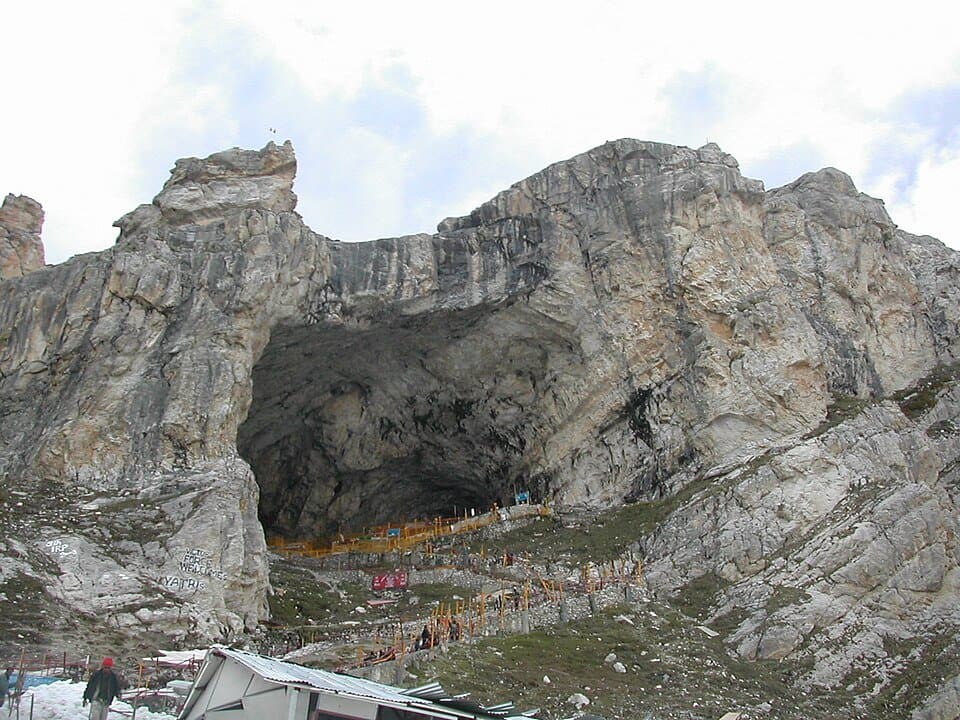
The Amarnath Cave sits in the Lidder Valley of Jammu and Kashmir. Inside the cave, an ice Shivalingam forms naturally each winter from the freezing of spring water and melts progressively through the summer. The lingam's size varies: in some years it reaches 6-7 feet in June, and by mid-August it can be down to 1-2 feet. I saw it in early July - about 5 feet tall, still clearly formed, with the base beginning to narrow.
Step 1 - SASB registration (do this first)
Registration is mandatory. You cannot enter the yatra route without a valid permit (Yatra Parchi). Security personnel check it at multiple points before the cave.
How to register: go to shriamarnathjishrine.com - the only official registration portal. SASB opens online registration typically in April each year, sometimes late March. The system runs on a slot-based model: you choose a specific date, a specific route (Baltal or Pahalgam), and a time slot. Once slots for a date are full, that date is closed.
Registration fee is approximately Rs 120 per person (verify current amount on the SASB site). Each individual registers separately. There is no group registration where one person covers multiple people.
You will need: Aadhaar card (or other valid government ID), a valid medical fitness certificate, mobile number for OTP verification, passport-size photograph.
After successful online registration, you receive a Yatra Parchi - print this and carry it throughout the trip. Digital copies on phones sometimes fail at checkposts with poor connectivity.
Bank registration (alternate channel): SASB has historically empanelled specific bank branches for offline registration - J&K Bank, Punjab National Bank, State Bank of India, and YES Bank branches in certain cities. You can walk in with your medical certificate and ID and register through the counter. This channel is useful if you face issues with the online portal or prefer in-person confirmation. The empanelled branch list is published on the SASB site and changes annually - do not use a previous year's list.
Registration tips: Register the day the portal opens. Slots for the first 3 weeks of the yatra (when the ice lingam is largest) fill within days. The SASB portal sometimes has traffic issues on opening day - try early morning or after midnight rather than 10 AM peak. The permit is non-transferable - if your dates change, you need to re-register.
Step 2 - Medical certificate (non-negotiable)
The medical certificate requirement exists because Amarnath involves rapid ascent to nearly 3,900m. The SASB format is specific - a general fitness certificate from your family doctor does not qualify.
You need a certificate on the prescribed SASB format, signed by a doctor at an empanelled hospital. SASB publishes the list of empanelled hospitals and doctors on its website - the list covers most major cities. The certificate must be obtained within 3 months of your yatra date.
The examination typically includes: blood pressure check, heart rate assessment, ECG for pilgrims above 50 years or those with cardiac history, diabetes and blood oxygen check at some centres.
Conditions that usually result in certificate denial: uncontrolled hypertension, recent cardiac events, severe anaemia, active respiratory infections, or pregnancy.
Cost varies by facility - government hospitals charge Rs 150-300, private empanelled clinics charge Rs 300-800.
My recommendation: do the medical check at least 3 weeks before your planned travel date. If there is any borderline result, you have time to consult further or postpone.
For detailed guidance on acclimatizing before a high-altitude pilgrimage, read the acclimatize-above-3000m guide - it is relevant even for Amarnath where you gain 1,200m+ in a single day on the Baltal route.
Baltal Route - 14 km, single day
Baltal base camp sits at 2,743m on the Srinagar-Leh national highway (NH-1), 93 km from Srinagar. The route from Baltal to the cave is 14 km one way - steep, direct, and unrelenting. You gain approximately 1,145m in those 14 km.
Most pilgrims on the Baltal route do it in a single long day. The standard approach: start between 2:00 AM and 3:30 AM to reach the cave by 7:00-8:00 AM, complete darshan, and return to base camp by 1:00-2:00 PM. Reason for the early start - beat the crowd at the cave (peak crowds 9:00-11:00 AM), and avoid afternoon weather. Afternoon thunderstorms and hail are common in July-August. Being on the exposed upper section of this route at 3:00 PM is not a situation you want.
The trail is not technical - you do not need climbing equipment or ropes. But it is steep and rocky in sections. The altitude gain happens fast.
When I did this route, the hardest section was the last 3 km before the cave - rocky terrain, thin air, and the cold at 4:30 AM even in early July. I was wearing three layers on top. The cave itself is enclosed in a natural amphitheatre - the sound of the waterfall near the shrine hits you before you see the lingam.
Ponies are limited on the Baltal route due to steep terrain. Most pilgrims walk.
Pahalgam Route - 46 km, 3-4 days
Pahalgam base camp is at 2,438m, 95 km from Srinagar via the Anantnag road. The total one-way distance from Pahalgam town to the cave is approximately 46 km, broken into stages across 3-4 days.
Staging camp sequence: Chandanwari (2,895m) at 16 km from Pahalgam - Sheshnag (3,590m) at 28 km - Panjtarni (3,657m) at 36 km - Amarnath Cave (3,888m) at approximately 46 km.
This route adds meaningful acclimatization. You sleep at increasing altitudes on consecutive nights - 2,895m, then 3,590m - before ascending to the cave. For older pilgrims, those with borderline medical results, or first-time high-altitude visitors, this multi-day structure is significantly safer than the single-day Baltal push.
Ponies and palanquins (palki) are available on the Pahalgam route at each stage camp. Pony rates are fixed by the SASB each season - approximately Rs 2,000-4,500 per stage depending on distance (confirm current rates on the SASB site). Palanquins cost more and are typically used by elderly pilgrims.
Route comparison summary: Baltal at 14 km, 1 day, base 2,743m, altitude gain ~1,145m, difficulty steep/demanding, best for fit pilgrims with limited time. Pahalgam at 46 km, 3-4 days, base 2,438m, altitude gain ~1,450m, difficulty moderate/gradual, best for older pilgrims, first-timers, those who want proper acclimatization. Crowd at cave: Baltal lighter if you start early, Pahalgam heavier as multi-day traffic converges at Panjtarni.
Helicopter booking - to Panjtarni only
SASB empanels helicopter operators for both routes. Primary operators in recent seasons: Aryan Aviation, Global Vectra Helicorp, and Pawan Hans. The helicopter does not fly to the cave itself - it flies to Panjtarni (3,657m), which is 5 km from the cave. You still walk or take a pony for the last 5 km.
Routes: Baltal to Panjtarni and back (Baltal-side pilgrims). Pahalgam to Panjtarni and back (Pahalgam-side pilgrims).
One-way fare: approximately Rs 2,500-3,500. Round trip: approximately Rs 5,000-7,000. These are indicative - SASB revises empanelled fares each season, and market rates depend on demand.
Helicopter slots sell out weeks before the yatra starts, especially for the first half of the season when the ice lingam is larger. Book the moment the booking portal opens. Operators have their own portals but SASB's site links to empanelled operators - use only those.
Important: helicopter services are subject to weather cancellations. If visibility drops, flights do not operate. Have a backup plan - the walk is the only alternative, and you need to be physically capable of it.
Getting there from Dehradun
Dehradun to Srinagar is 700 km via the Jammu route - NH-44 to Jammu (294 km, 6-7 hours), then the Jammu-Srinagar national highway (270 km, 8-10 hours depending on traffic and road conditions at Banihal tunnel). Total ground travel: 14-16 hours minimum. This is a viable option if you are driving your own vehicle or taking a bus, but it is a full-day journey with the Banihal section being slow.
The faster option is the Dehradun-Srinagar flight. IndiGo and Air India both operate this route. Flight time 1.5 hours. Fares start around Rs 3,500-5,500 one way if booked 3-4 weeks ahead, can spike to Rs 8,000+ in peak yatra season (July). Book your Srinagar flight early - the same dates that Amarnath registration opens are the dates Srinagar airfares start climbing.
From Srinagar, shared taxis and JKSRTC buses run to both Pahalgam (95 km, 2.5-3 hours) and Baltal (93 km, 2-2.5 hours). Private taxi from Srinagar to Baltal Rs 2,500-3,500. To Pahalgam, Rs 1,500-2,500 for a shared vehicle.
I drove Dehradun to Jammu overnight (left at 10 PM, reached Jammu by 5 AM), then took a shared taxi on the Jammu-Srinagar highway. The Banihal section post-tunnel is much faster than the old road - the 8-km tunnel cuts nearly 30 km of mountain road. Still, the highway is busy with Army and civilian traffic and speed is limited.
If you are driving, read the monsoon-routes guide before you attempt the Jammu-Srinagar highway in July-August. Landslides close it multiple times each monsoon season.
What to carry on the trail
The Baltal route is a full-day mountain trek at altitude. The Pahalgam route is multi-day camping. Your kit differs significantly.
For Baltal (single day): daypack 20-25L. 2 litres of water minimum (there are taps and stream sources on the trail but do not rely on them exclusively). Warm mid-layer and wind/rain shell - temperatures at 3:30 AM at Baltal can be 3-6C in July. Thermal base layer. Rain poncho - afternoon showers are common even if the morning was clear. Trekking shoes with ankle support. Headlamp with fresh batteries - mandatory for a 2:30 AM start. Personal medication, any prescription drugs, and a basic first aid kit. Snacks: dry fruits, energy bars, glucose biscuits. Plastic bags to wrap electronics and documents inside your pack (plastic bags are banned for carrying items externally - use them inside your pack to waterproof).
Additional for Pahalgam (multi-day): sleeping bag rated to -5C minimum - Sheshnag at 3,590m is cold at night even in July. Change of clothes for 3 nights. Trekking poles - useful on the longer gradual climbs. Portable charger - mobile charging at camps is available but unreliable.
What not to carry: plastic carry bags (banned in the entire zone). Drones (banned completely - confiscated at entry). Heavy luggage - there are cloak rooms at both base camps.
See jackets-kedarnath-trek, thermals-high-altitude, rain-ponchos-char-dham, trekking-shoes-under-5000, headlamps-under-1000, backpacks-chopta-tungnath, and sleeping-bags-spiti gear pages for specific picks.
Connectivity, cash, security
Mobile connectivity in the Amarnath zone is a known limitation. BSNL SIM cards work at most camps and at both base camps. Private operators (Jio, Airtel, Vi) have limited or no signal beyond Baltal or Pahalgam town. If you rely on a private SIM, buy a BSNL tourist SIM in Srinagar before travelling to the base camp.
ATMs: Pahalgam town has ATMs from SBI, J&K Bank, and PNB - use them before you leave for the camp. Baltal base camp has limited banking infrastructure. The atm-cash-guide covers withdrawal limits and reliability for this corridor.
Carry a minimum of Rs 5,000-7,000 cash from Pahalgam/Baltal. You will need cash for ponies, food at camps, cloak room charges, and any porter hire. Most camp food stalls are cash-only.
Security: the Amarnath Yatra is one of the most heavily secured pilgrimage operations in India. The route is covered by CRPF, J&K Police, and Army at multiple points. Pilgrim convoys are escorted, and base camps have permanent security presence. Pilgrims are not required to arrange their own security. The check-in/check-out process at each camp records pilgrim movement.
Register your departure time from each camp with the SASB camp office. This is a safety protocol - if you do not check in at the next camp within expected time, a search is initiated.
Weather - what July and August look like
The Amarnath yatra runs during the monsoon. That is not a coincidence - the religious calendar is fixed - but it does mean you are trekking in monsoon conditions.
Typical weather pattern at Baltal and Pahalgam base camps in July: mornings clear, cold (4-10C), good visibility. Afternoons cloud buildup, rain or hail likely by 1:00-3:00 PM. Evenings often clear again briefly, then cold overnight (0-5C).
On the trail above 3,500m, snow is possible at any point in July. I had light sleet for 20 minutes on the final approach to the cave in early July - it stopped quickly, but the rocks became slippery. Waterproof trail shoes or gaiters matter here.
The SASB suspends the yatra temporarily if weather conditions become dangerous - this has happened in past seasons. Check weather forecasts from IMD (India Meteorological Department) and SASB advisories in the days before your yatra date.
A note on the ice lingam: the lingam is largest in June-early July and smallest by late August-September. If seeing the lingam at its largest matters to you, register for the first two weeks of the yatra season. The SASB site publishes periodic size updates during the season when significant changes are noted. The lingam melts from the base upward - a 6-foot formation in early July can be 18 inches by late August in a warm year.
Budget breakdown
Option A - Baltal route, self-trek, camp dormitory:
Dehradun to Srinagar (bus + taxi via Jammu) Rs 1,500-2,000. Srinagar to Baltal (shared taxi) Rs 500-800. SASB registration Rs 120. Medical certificate Rs 300-500. Base camp dormitory (1 night) Rs 300-600. Meals at base camp + trail (2 days) Rs 800-1,200. Miscellaneous (cloak room, tips, snacks) Rs 500-800. Total excluding gear: Rs 4,000-6,000.
From Dehradun via flight (Dehradun-Srinagar one way Rs 3,500-5,500), total rises to Rs 8,000-12,000.
Option B - Pahalgam route with helicopter one way:
Dehradun to Srinagar (flight) Rs 4,000-6,000. Srinagar to Pahalgam (taxi) Rs 1,500-2,000. SASB registration + medical certificate Rs 500-700. Camp stays (3-4 nights, tent/dormitory) Rs 1,500-3,000. Helicopter one way (Pahalgam to Panjtarni) Rs 2,500-3,500. Pony for return sections Rs 2,000-4,000. Meals (4-5 days) Rs 2,500-4,000. Total: Rs 14,500-23,200.
For gear if you need to buy cold weather items, see the thermals, jacket, and headlamps guides.
Connections from Amarnath
If you are combining Amarnath with other destinations, here are logical pairings:
Ladakh: Baltal base camp is on the Srinagar-Leh highway. After completing the yatra from Baltal, you can continue eastward to Leh (approximately 240 km, 6-7 hours). This is a popular add-on - see the ladakh page for what follows.
Rishikesh: Many pilgrims from Uttarakhand and UP route through Dehradun/Haridwar. The Dehradun-to-Srinagar connection makes Rishikesh a natural pre/post stop.
Kedarnath: Kedarnath and Amarnath in the same trip requires careful planning around overlapping dates and registration windows. Kedarnath opens in May; Amarnath opens in July. A June-July window where you do Kedarnath in late June and Amarnath in early July is feasible.
Useful links: shriamarnathjishrine.com (official SASB registration). jktourism.jk.gov.in (J&K Tourism travel advisories). SASB empanelled hospitals list (for medical certificate) is published on the SASB site under the Health or Registration section each season.
When to go
What to pack
A full packing checklist is available to tick off and share. Start with these essentials, then adjust for the current forecast, route and your own needs: